
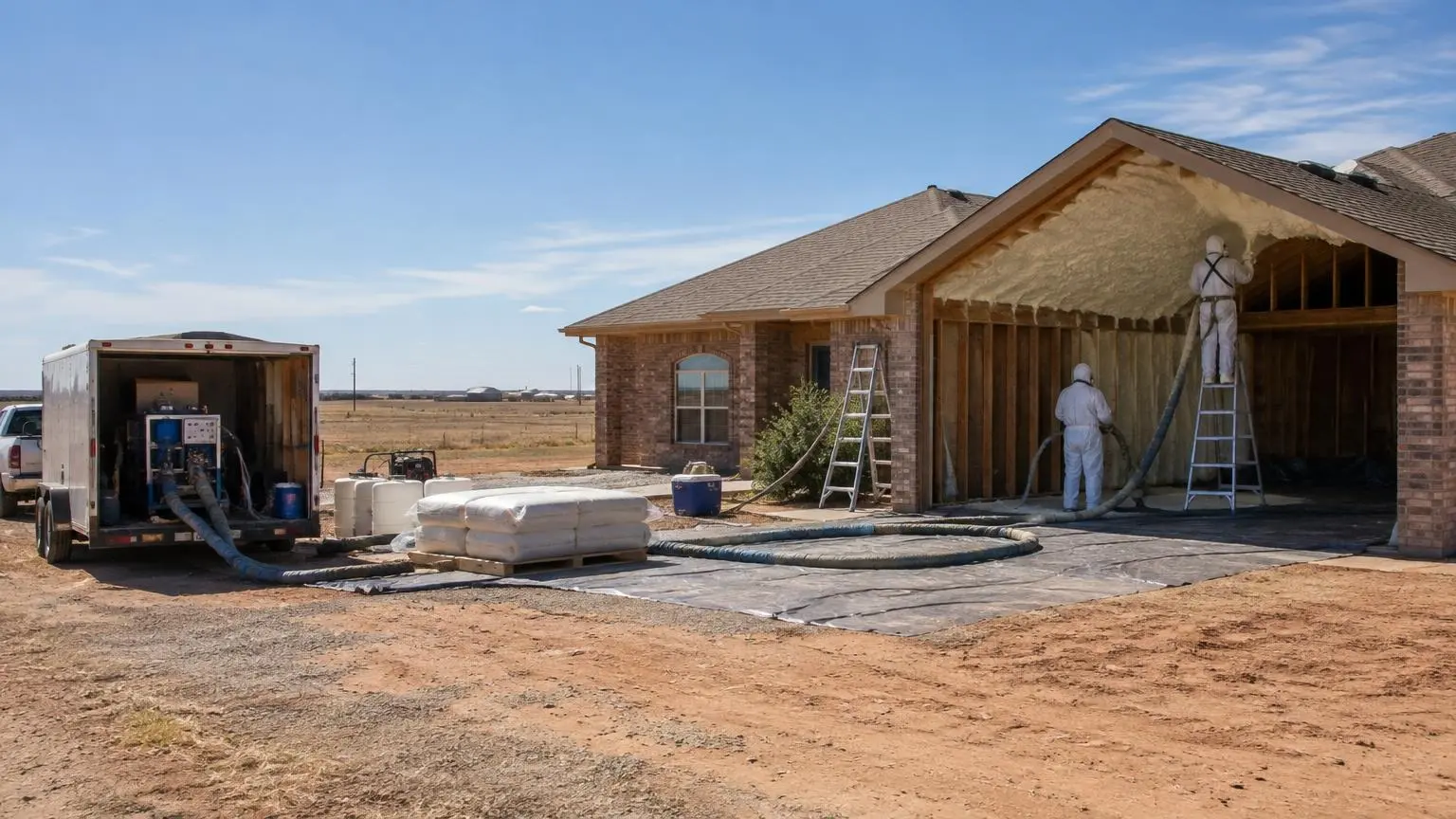
Homes, shops and flat roofs across the South Plains
Spray Foam Insulation in Lubbock, TX
Keep the summer heat out of the attic, the wind out of the walls and the drip off the steel, with every foam and price written down before work starts.
- Free on-site estimates
- Written quotes that name foam type, thickness and R-value
- Attic ducts, roof leaks and old insulation checked before we spray
Insulation for 100-Degree Afternoons and Below-Zero Records
Spray foam insulation in Lubbock has to handle two very different seasons. Wikipedia's 1991-2020 climate table for the city shows July afternoons averaging 93.4F, about 92 days a year at 90F or hotter and 13.3 days at 100F or more, yet January mornings average 27.2F and the record low is -17F. Add an average wind speed of 12.4 mph, which ranks Lubbock among the ten windiest U.S. cities, and every gap in a house's shell gets tested all year. We seal those gaps and insulate the spaces that need it, with open-cell or closed-cell spray foam where it pays and blown-in insulation where that does the job for less.
What the code asks for in Lubbock
OpenEI's climate zone listing places Lubbock County in Climate Zone 3B, a dry zone. The City of Lubbock adopted the 2021 International Energy Conservation Code with local amendments in Ordinance 2024-00031, read a second time in March 2024. The ordinance's insulation table lists R-38 for ceilings, R-13 for wood-frame walls and R-19 for floors, and it calls for at least R-6 on supply and return ducts in attics. For existing homes, ENERGY STAR's retrofit table recommends R-49 for an uninsulated Zone 3 attic, or adding R-38 where 3 to 4 inches already sit on the attic floor. Many towns we serve to the northwest, including Levelland and Littlefield, sit in Hockley and Lamb counties, which OpenEI lists in Zone 4B. ENERGY STAR's numbers rise there to R-60 for a bare attic.
Where South Plains houses lose comfort
In most Lubbock houses the attic is the problem. On a summer afternoon it fills with heat, and the ductwork and air handler often sit right in it. Warm attic air leaks down through recessed lights, the attic hatch, bath fans, plumbing and flue chases and the tops of interior walls, while cool conditioned air leaks up. Thin or packed-down insulation lets the ceiling radiate heat into the rooms below. The result is a hot upstairs, an air conditioner that runs all afternoon and dust that finds its way in on windy days.
Lubbock's housing stock is large and mixed. The 2020 census counted 111,247 housing units in the city, with 9.6% vacant and a homeowner vacancy rate of only 1.5%. The city was incorporated in 1909 and has grown ever since, so its neighborhoods mix older houses with much newer ones. Each age of house leaks in its own spots, so we inspect before we recommend anything.
Closed cell vs open cell foam
Open-cell foam is soft and light. It expands a lot, fills odd-shaped cavities, blocks air and dampens sound, and HomeGuide lists it at R-3.5 to R-3.7 per inch. Closed-cell foam is dense and rigid at R-5 to R-7 per inch. It slows water vapor, resists water and adds some stiffness to what it is sprayed on. In our dry climate, open-cell is a common choice under the roof deck of a house when the ducts are in the attic, and in interior and exterior wall cavities. Closed-cell is the usual pick on metal buildings, where it stops condensation on cold steel, and anywhere we need a lot of R-value in a thin space. We name the foam for each area on the quote.
Metal shops, barns and flat roofs
The Lubbock area is described as the largest contiguous cotton-growing region in the world, and the farm towns around it are full of steel shops, equipment barns and gin buildings. Uninsulated steel bakes in summer and drips condensation when warm, moist air meets cold metal in winter. Closed-cell foam on the panels and purlins insulates and seals in one step. On commercial buildings with low-slope roofs, spray foam roofing adds a seamless layer of insulation on top of the deck, finished with a coating that faces the sun and the hail.
What to ask insulation contractors before you hire
When you talk with spray foam insulation contractors or insulation companies around Lubbock, ask what they will seal before they insulate. Ask which foam they plan for each area, what thickness and R-value the quote lists, and what happens to the old insulation. Ask how they handle the attic ducts and the air handler, how they ventilate during spraying, and how long the household should stay out afterward (HomeGuide's guidance is 24 hours or more). If you searched for spray foam insulation near me and have several bids, line them up by thickness and R-value per area, not just the total.
Spray foam insulation cost
HomeGuide's 2026 guide puts installed spray foam at $1.50 to $5.00 per square foot: $1.50 to $3.50 for open-cell and $3.00 to $5.00 for closed-cell. It lists foaming an attic at $3,000 to $8,000 and a whole house at $8,000 to $20,000, and notes that many installers set a job minimum of $1,000 to $2,000 or more. Blown-in insulation runs $1.00 to $2.80 per square foot in HomeGuide's blown-in guide. These national ranges are a starting point; access, depth, foam type and removal set the real number, and the written estimate we hand you is the price.
Timing work around Lubbock weather
Wikipedia notes that Lubbock sits on the southwestern edge of Tornado Alley and that spring brings the risk of very large hail. Roof work is best planned around those storms, and attic work is easier in the morning or in the cooler months than on a 100-degree July afternoon. Foam can be sprayed year-round in conditioned spaces. Call early in spring if you want the attic done before summer.
What We Do
Six kinds of work, matched to each part of the building, from foam under the roof deck to a fresh coated foam roof on top of it.
Spray Foam Insulation
Open-cell and closed-cell foam that insulates and stops air in one layer, for rooflines, walls, shops and tight spaces.
Learn more →Attic Air Sealing & Insulation
Seal the leaks in the attic floor, then bring the insulation to depth with blown-in or foam, including the space around attic ducts.
Learn more →Spray Foam Roofing
Seamless foam applied on top of low-slope roofs and finished with a reflective coating, for commercial and agricultural buildings.
Learn more →Metal Building & Shop Insulation
Closed-cell foam on steel shops, barns and equipment sheds to stop condensation and keep the building workable year-round.
Learn more →Wall Insulation
Spray foam in open stud bays for new homes and remodels, and blown-in or injected insulation for closed walls.
Learn more →Insulation Removal & Replacement
Vacuum out old, soiled or packed-down insulation, seal the attic, and install new insulation to depth.
Learn more →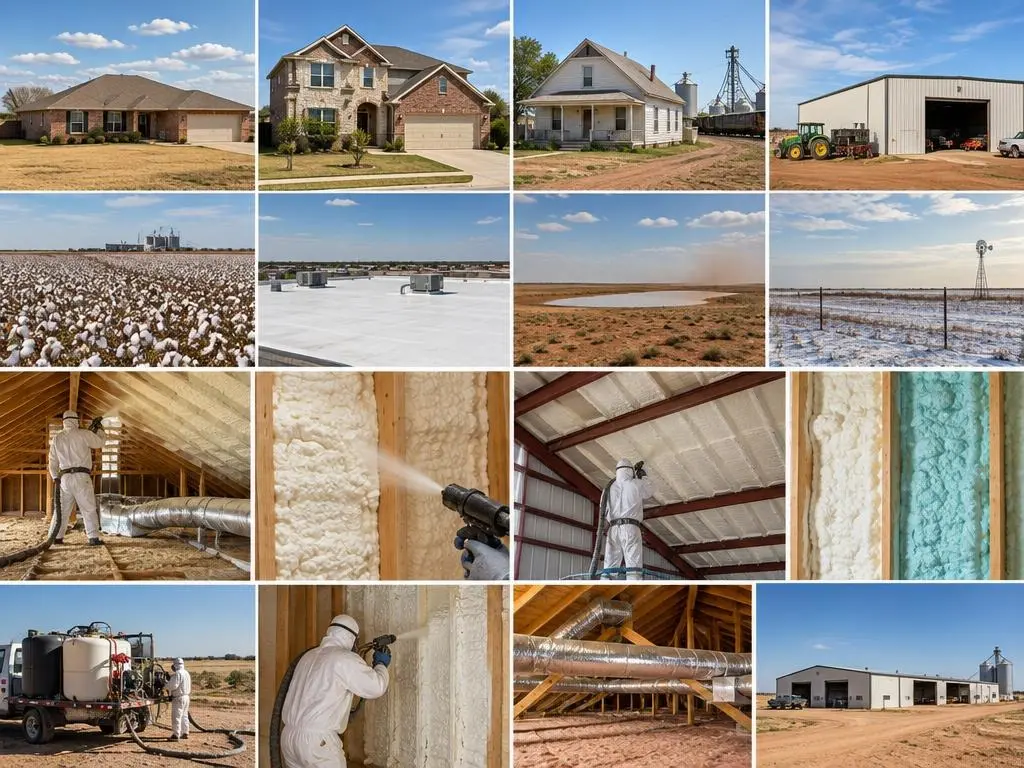
Why Homeowners Call Spray Foam Insulation Lubbock
We look before we price
Every quote follows a visit to the attic, walls, shop or roof, not a guess over the phone.
Seal first, then insulate
Chases, top plates, hatches and duct boots are sealed before new insulation covers them.
Material matched to the job
Open-cell, closed-cell, cellulose or fiberglass, chosen for the surface and the climate zone, with the reason written down.
Quotes you can compare
Each area lists material, thickness or depth, target R-value and price, so bids line up fairly.
Towns We Serve on the South Plains
We work in Lubbock and the towns around it: Wolfforth, Shallowater, Idalou, New Deal, Ransom Canyon and Slaton in Lubbock County; Abernathy on the Hale County line; Lorenzo and Ralls in Crosby County; Levelland in Hockley County and Littlefield in Lamb County to the west and northwest; Brownfield in Terry County; Tahoka in Lynn County; and Post below the Caprock in Garza County. The growing suburbs are full of newer houses and new construction, the older railroad and cotton towns have more frame houses and metal farm buildings, and the northwest counties fall in a colder climate zone than Lubbock. Each town page covers what is different there.
- Spray Foam Insulation in Lubbock, TX
- Spray Foam Insulation in Wolfforth, TX
- Spray Foam Insulation in Shallowater, TX
- Spray Foam Insulation in Idalou, TX
- Spray Foam Insulation in Slaton, TX
- Spray Foam Insulation in Ransom Canyon, TX
- Spray Foam Insulation in Abernathy, TX
- Spray Foam Insulation in New Deal, TX
- Spray Foam Insulation in Lorenzo, TX
- Spray Foam Insulation in Ralls, TX
- Spray Foam Insulation in Levelland, TX
- Spray Foam Insulation in Littlefield, TX
- Spray Foam Insulation in Brownfield, TX
- Spray Foam Insulation in Tahoka, TX
- Spray Foam Insulation in Post, TX
Common Questions
Is spray foam worth it in Lubbock's dry climate?
Often yes in the attic, especially when ducts and the air handler are up there, and nearly always on metal shops and barns. On a simple attic floor with no ducts, sealing the leaks and blowing in loose fill can deliver most of the comfort for less money. We price both where both would work.
Should I use closed cell or open cell spray foam?
In Lubbock homes, open-cell is common under the roof deck and in wall cavities because it seals air well and costs less per square foot. Closed-cell is the usual choice on steel buildings and in tight spaces that need more R-value per inch. The quote names the foam for each area.
How much does spray foam insulation cost in Lubbock?
HomeGuide's national figures put installed spray foam at $1.50 to $5.00 per square foot and a foamed attic at $3,000 to $8,000. Area, foam type, thickness, access and any removal move the total. The written estimate after our visit is the price.
Can mold grow behind spray foam insulation?
Foam itself is not food for mold, but mold can grow on wood or drywall that stays wet. That happens when foam covers an active roof or plumbing leak, or when moisture is trapped by the wrong foam in the wrong place. We look for leaks and damp framing before we spray, and leaks get fixed first.
Is there a DIY spray foam kit available?
Yes, two-part foam kits and cans of gap sealant are sold at home stores, and the cans are handy for small gaps. Large areas are harder: the chemicals need the right temperature and mix, thickness is hard to control, and the job calls for protective gear and ventilation. For an attic, shop or roof, a professional rig gives a more even result.
Who manufactures spray foam insulation?
Spray foam is a two-part system made by chemical and building-products companies, and installers buy it under various brand names. What matters more for your house is the type (open or closed cell), the thickness and how it is installed. We list the foam type and thickness on your quote and can tell you the product we plan to use.
What R-value does the Lubbock code require for an attic?
The City of Lubbock's 2024 energy code ordinance lists R-38 for ceilings in new work. For existing homes, ENERGY STAR recommends R-49 for an uninsulated Zone 3 attic. Towns in Hockley and Lamb counties are in Zone 4B, where ENERGY STAR suggests R-60. Check with your building office before a remodel.
Does spray foam help with dust on windy days?
Air sealing helps. Dust gets in where outside air leaks in, through gaps in the attic floor, around doors and at plumbing and wiring holes. Foam fills those gaps and blocks air in the same layer, so less unfiltered air is pulled into the house when the wind blows.
Get a Written Insulation Quote
We come out, look at the attic, walls, shop or roof, and send a written price with the material and R-value for each area.